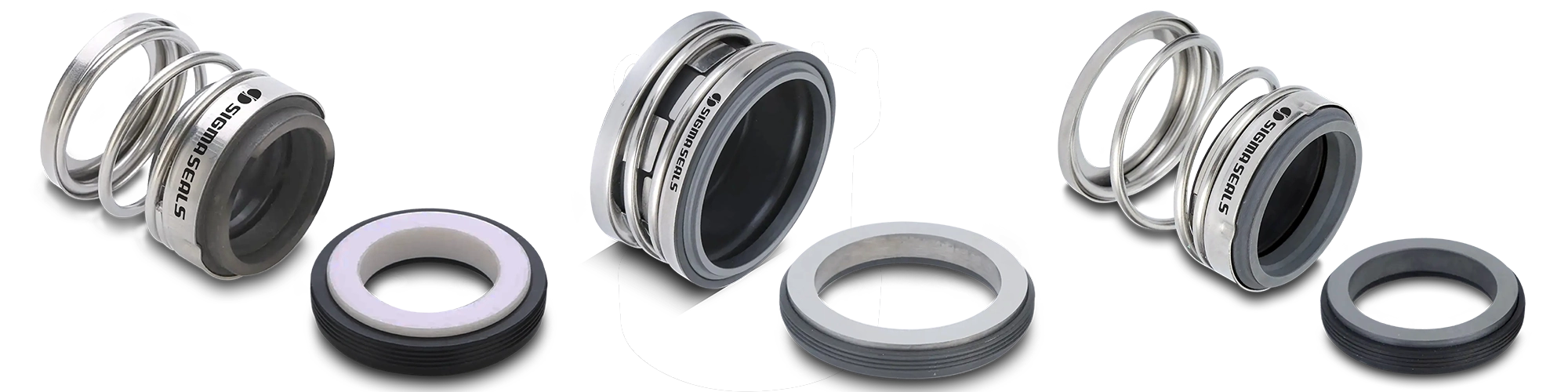
Rubber Bellow Mechanical Seals are designed to provide reliable sealing integrity under extreme pressure and temperature conditions. These seals are used in wide range of equipment, particularly in pumps and valves, to prevent leakage of fluids. Rubber bellow seals are typically made of flexible rubber and consist of a metal bellow body pre-filled with the desired sealing liquid.
The metal bellow body can be constructed using stainless steel, carbon steel, bronze, etc., and it is designed to withstand pressure and temperature higher than that of the sealing liquid. The use of a bellow also enables the seal to absorb unavoidable axial movements of the shaft, or expansion of the sleeve due to temperature, ensuring that the seal remains leak-free.
The most common types of rubber bellow seals are single and double acting. Single acting seals have a single, flexible rubber bellow, while double acting seals incorporate two bellows pressed against each other. Double acting seals are generally better suited for higher temperature and pressure applications.
Rubber bellow seals can be either externally or internally pressurized. In externally pressurized seals, a liquid, such as oil, is forced through an external annular passage and into the bellow, increasing the bellow’s pressure and providing effective sealing action. On the other hand, internal pressurization utilizes a spring-like mechanism to effectively restrict the compressed rubber against the equipment to provide leak-free, tight seal.
In addition, rubber bellow seals can be categorized based on the type of sealing liquid used. Generally, seawater, oil, and gas are used in different applications. Seawater is best suited for harsh environments, such as those found in deep sea drilling. Oil is used in low pressure systems, while gas is commonly used in higher pressure applications.
Overall, rubber bellow mechanical seals are used in a wide range of equipment, from pumps to valves and are efficient in preventing leakage of liquids or gases. Since rubber bellows are flexible and easy to form, they can effectively react to changes in degree of movement or temperature, maintaining a tight seal over time.